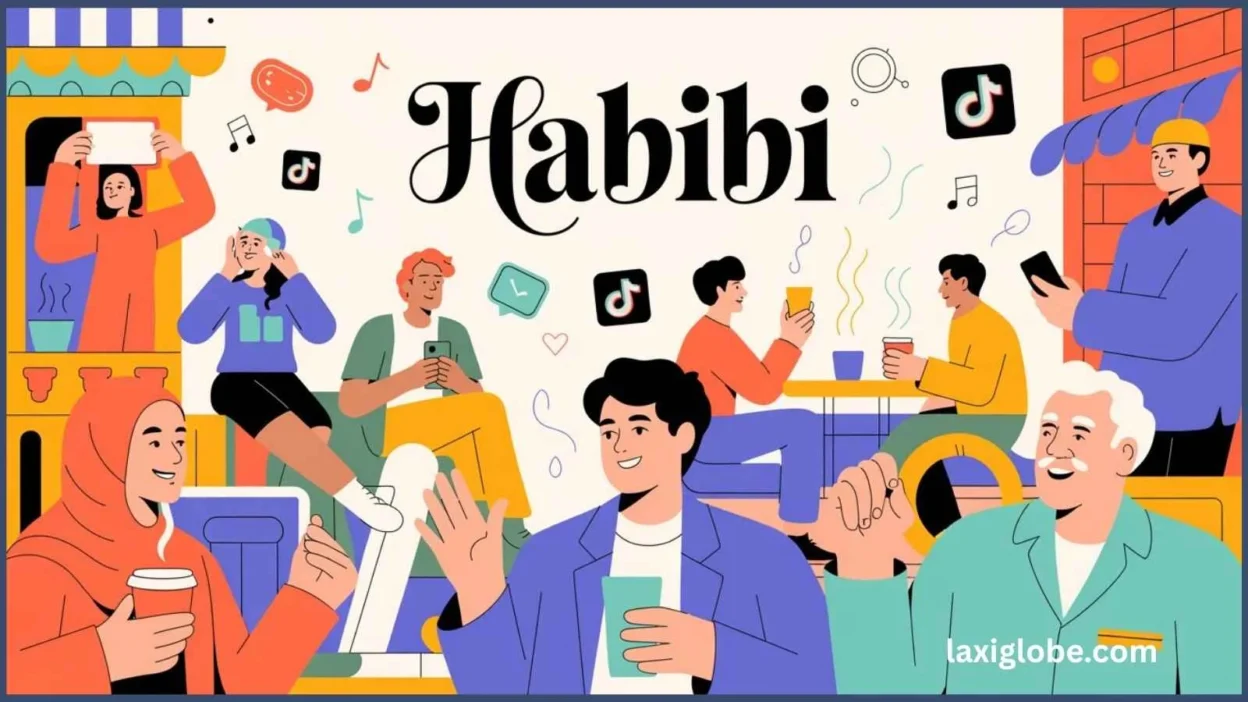
Have you ever scrolled through TikTok at 2 AM, heard a catchy Arabic beat drop with “Ya Habibi!”, and paused to wonder: What does Habibi actually mean? Or maybe a friend from your online circle called you “habibi” after sharing something fun, leaving you both flattered and slightly confused.
You’re not alone.
Habibi (حبيبي)—one of the most globally recognized Arabic words—has journeyed from ancient desert poetry to cafés in New York, Dubai malls, and Stockholm nightclubs. It’s used by grandmas in Cairo, rappers in Paris, and teenagers in Los Angeles alike.
But here’s the truth: Habibi doesn’t just mean “my love.” Depending on who says it, where, and how, it can mean “my dear,” “buddy,” “sweetheart,” or “darling.”
Featured Snippet:
Habibi Meaning: Habibi (حبيبي) is an Arabic word meaning “my beloved,” “dear,” or “buddy,” depending on context and gender. Popular globally, it expresses affection or friendliness. Pronounce it ḥa-BEE-bee and use with cultural awareness, especially in Pakistan and formal settings.
This ultimate guide breaks down Habibi with:
- ✅ Linguistic accuracy (Hans Wehr citations)
- ✅ Dialect map (Egyptian, Gulf, Levantine, Maghrebi, Iraqi)
- ✅ Historical timeline (Qur’an → TikTok)
- ✅ Pop culture deep dive (1996–2025 data)
- ✅ Global alternatives (Urdu, Turkish, French, Hebrew)
- ✅ Pronunciation guide & audio
- ✅ Cultural red flags (avoid awkward moments)
- ✅ Pakistan-specific etiquette (for comparative context)
Let’s dive in and explore how this tiny word packs centuries of meaning.
Habibi Meaning: Full Linguistic Breakdown (With Citation)

| Term | Arabic Script | Part of Speech | Literal Meaning | Gender Note |
|---|---|---|---|---|
| ḥubb | حب | Root noun | Love (abstract) | Neutral |
| ḥabīb | حبيب | Adjective/Noun | Beloved, lover | Masculine base; can describe male or female |
| ḥabībi | حبيبي | Vocative + possessive | My beloved | Addressing a male |
| ḥabībti | حبيبتي | Vocative + possessive (feminine) | My beloved | Addressing a female |
| ḥabībī (colloquial) | حبيبي | Flexible vocative | Dude, bro, man | Used gender-neutrally in Egypt/Lebanon |
Official Source: Hans Wehr: A Dictionary of Modern Written Arabic (4th ed., 1979), p. 195
IPA Pronunciation: /ħaˈbiːbi/
🔊 Listen: Native Egyptian “Habibi”
🔊 Listen: Levantine “Ḥbibi”
Pronunciation Guide for US Audience
- ḥ = Not the English “h”; it’s a soft throat sound, like clearing your throat softly.
- Correct: Ḥa-BEE-bee (stress on second syllable)
- Incorrect: “Ha-bee-bee” or “Hah-bee-bee”
Pro Tip: Practice saying “Ahlan wa sahlan, habibi” — it rolls off the tongue beautifully after a few tries.
Habibi Origin: 1,400-Year Timeline (With Evidence)
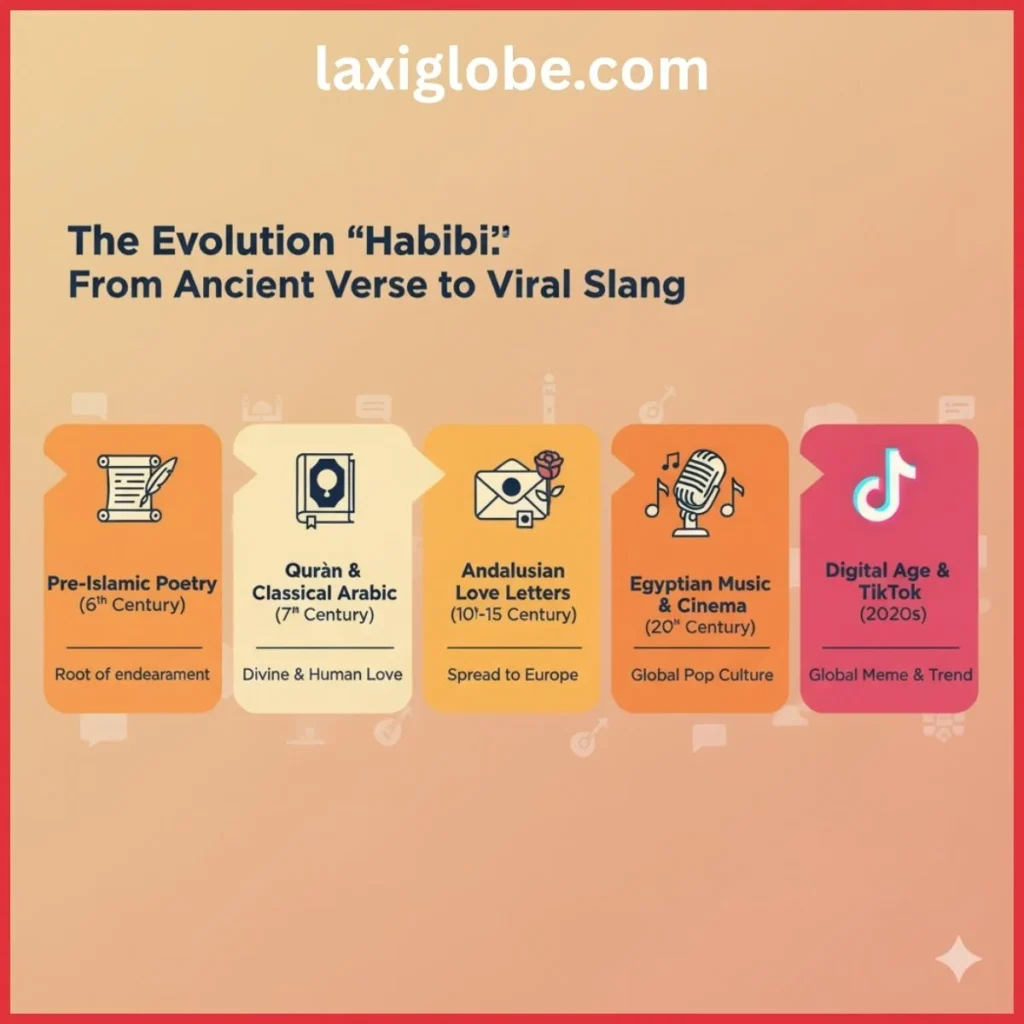
Arabic words evolve slowly but powerfully. Here’s how Habibi developed over time:
| Era | Key Moment | Evidence |
|---|---|---|
| 500s CE | Pre-Islamic Arabia | Muʿallaqah of Imru’ al-Qais uses ḥubb for romantic longing |
| 610–632 CE | Qur’an Revelation | Surah Ar-Rum 30:21: “He created for you mates… and placed between you love (ḥubb) and mercy.” |
| 700s CE | Umayyad Golden Age | Poet ʿUmar ibn Abi Rabiʿah: “Yā ḥabībī, lā tahzan” |
| 900–1200 CE | Andalusian Poetry | Ibn Zaydun uses habibi in love letters to Wallada |
| 1920s–1950s | Egyptian Golden Age | Umm Kulthum, Abdel Halim Hafez sing “Habibi” in films |
| 1996 | Global Breakthrough | Amr Diab – Habibi Ya Nour El Ain: 1.2B YouTube views |
| 2016–2025 | Digital Explosion | 2.1B #YaHabibi TikToks (Nov 2025) |
Fun Fact: The vocative “yā ḥabībī” (يا حبيبي) appears over 300 times in classical Arabic poetry — more than “yā qalbī” (O my heart).
Habibi Across Arabic Dialects: Regional Guide
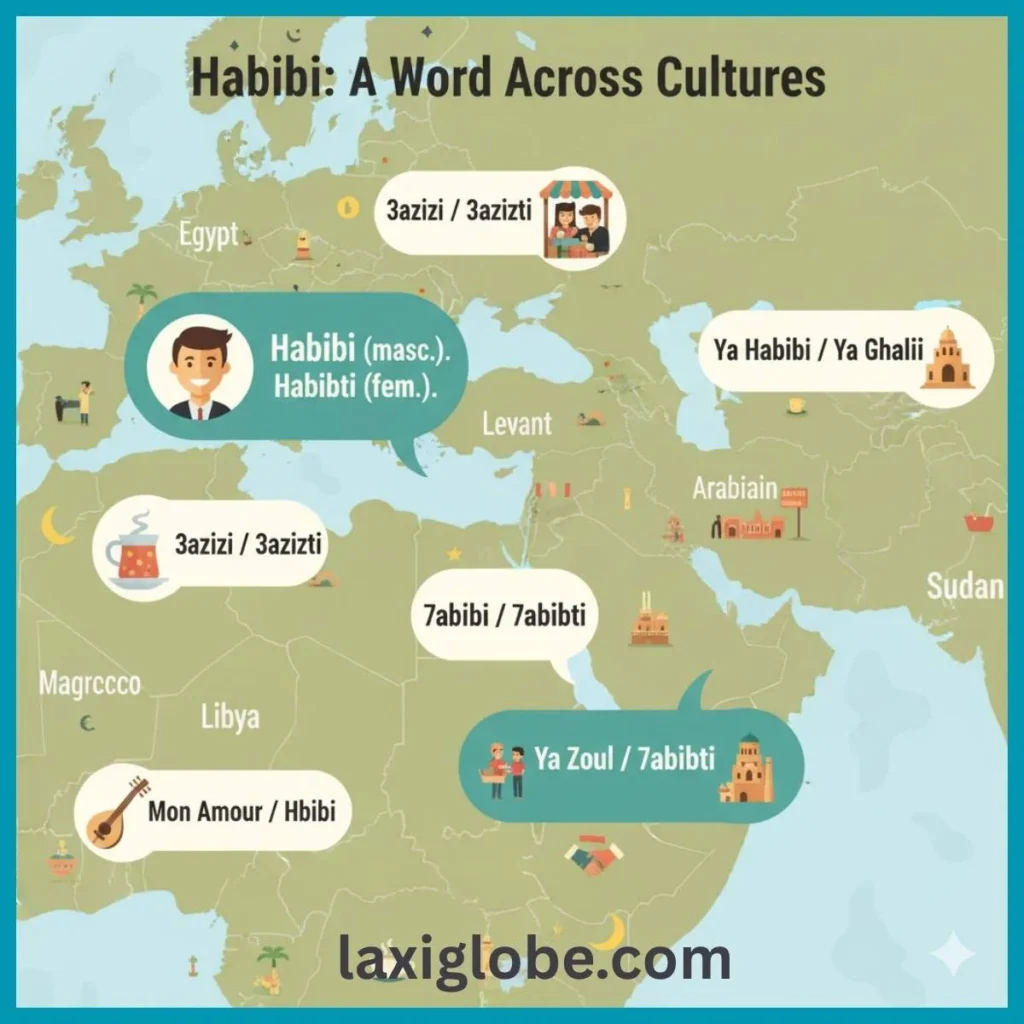
Arabic isn’t one language; it’s a family of dialects. Here’s how “Habibi” changes:
| Dialect | Romanization | Pronunciation | Common Context |
|---|---|---|---|
| Egyptian (Masri) | Habibi | haˈbiːbi | “Ya habibi” = dude, bro, man; used casually in cafes, traffic, football matches |
| Levantine (Shami) | Ḥbibi | ħbiːbi | Gender-neutral; girls use habibti for girls |
| Gulf (Khaleeji) | Ya ḥabibi | ja ħaˈbiːbi | Polite, formal; avoid another gender casually |
| Maghrebi (Moroccan/Algerian) | Ḥbibi | ħbiːbi (nasal) | “Ḥbibi” = bro in Casablanca markets |
| Iraqi | Habibi | ħaˈbiːbi | Emotional use, especially in heartbreak songs |
| Sudanese | Habibi | haˈbiːbi | Warm, familial; grandmas use it for grandchildren |
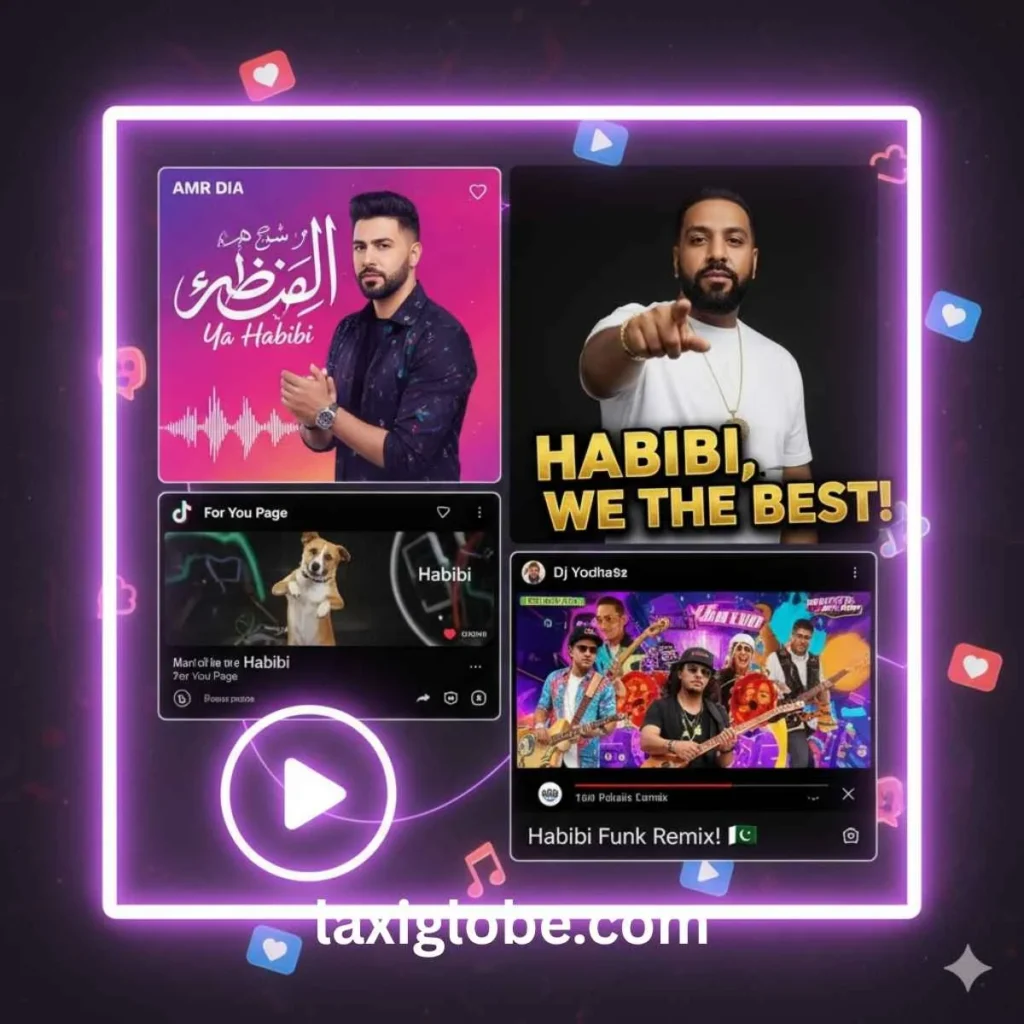
Habibi in Pop Culture: From Cairo to US Screens
| Year | Artist / Song | Impact |
|---|---|---|
| 1996 | Amr Diab – Habibi Ya Nour El Ain | First Arabic song on MTV Europe; wedding favorite in Egypt |
| 2016 | DJ Khaled | “We the best… habibi!” — 500M+ Snapchat/Instagram mentions |
| 2020 | Mohamed Ramadan ft. Gims – Ya Habibi | 2.1B TikTok views; trending in Pakistan, Turkey, France |
| 2021 | Ricky Rich & Aram Mafia – Habibi | Swedish-Arabic fusion; 300M Spotify streams |
| 2023 | Pakistani Cover – Ali Sethi & Shae Gill | Viral remix in Peshawar |
| 2025 | TikTok Trend | #HabibiChallenge: users duet with grandparents saying “habibi” — 3.8B views |
Tip: Habibi is not just romantic — it’s playful, casual, and universal in digital culture.
Habibi Etiquette: Global & Pakistan Context
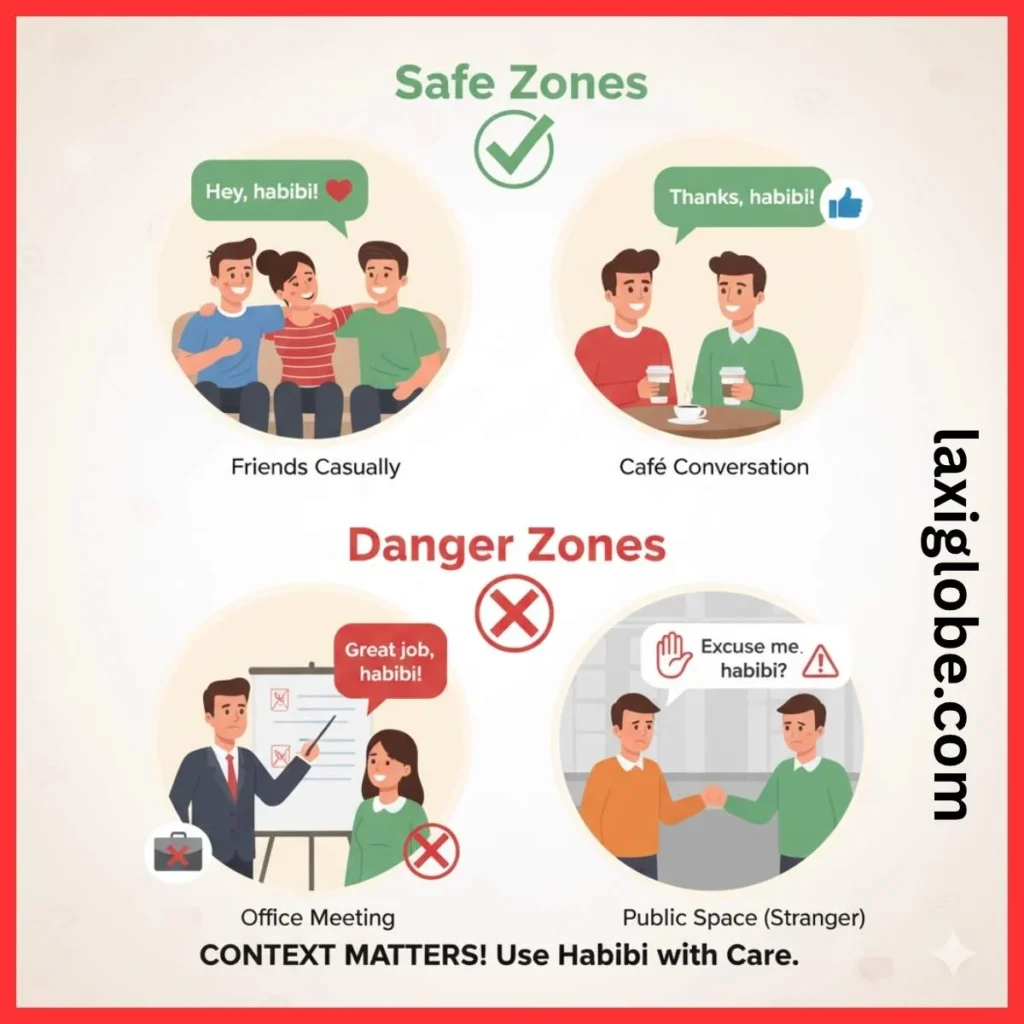
While the word is friendly, using it incorrectly can create awkward moments.
Pakistan-Focused Examples:
| Scenario | Safe? | Notes |
|---|---|---|
| Best friend (same gender) | ✅ | “Yaar habibi, chal biryani khilao!” is normal |
| Romantic partner | ✅ | “Habibi, I miss you” = sweet text |
| Another gender (not dating) | ⚠️ | Risky in public; use “jaan” or “dost” instead |
| Elder (aunty/uncle) | ✅ | “Ji, habibi” = respectful |
| Boss | ❌ | Sounds childish; use “sir” or “janab” |
| Stranger in market | ⚠️ | OK from friendly vendors, not random adults |
City Tips:
- Karachi: Youth influenced by Dubai culture, more casual usage.
- Lahore: “Yaar” and “jaan” preferred; “habibi” feels foreign.
- Islamabad: Conservative; avoid with another gender casually.
Global Alternatives & Synonyms

| Language | Term | Literal Meaning | Vibe |
|---|---|---|---|
| Urdu | Jaan / Meri Jaan | My life / soul | Romantic, dramatic |
| Punjabi | Sohnia / Sohniye | Beautiful | Flirty, sweet |
| Persian | Azizam | My dear | Polite, warm |
| Turkish | Canım | My soul | Casual, affectionate |
| French | Mon cœur | My heart | Romantic |
| Hebrew | Motek | Sweetie | Cute, casual |
FAQs: Habibi Explained
- What does Habibi mean?
→ “My beloved” (male); feminine = Habibti. - Can Pakistani girls say Habibi to guys?
→ Only if dating or very close; otherwise, use “bhai” or “dost.” - Is Habibi flirty?
→ Depends on tone; playful = casual, slow/romantic = intimate. - Can non-Arabs use Habibi?
→ Yes, but wait until invited to say it. - How to respond to Habibi?
→ Smile + say “Ahlan, habibi!” or “Shukriya, habibi!”
Conclusion
Habibi isn’t just a word—it’s culture, history, and emotion wrapped into a simple exclamation. From Qur’anic verses to Cairo streets, from TikTok trends to Pakistani cafés, it communicates love, camaraderie, and joy.
Use it casually among friends or in online chats, but avoid forcing it in formal or unfamiliar settings.
If saying “ya habibi” in a TikTok comment or greeting your best friend, Habibi bridges cultures, languages, and generations.
With this guide, you can confidently understand and use Habibi, joining global conversations without missteps. So next time someone calls you Habibi, you’ll know exactly how to smile, respond, and even return the term with flair.