Featured Snippet
Definition: ML to OZ conversion is the process of converting milliliters (ml), a metric unit of liquid volume, into ounces (oz), a common imperial measurement.One US fluid ounce equals approximately 29.5735 milliliters, while a UK (imperial) fluid ounce equals about 28.413 milliliters.
Accurate conversion ensures correct liquid measurements in recipes, drinks, and medicine. Understanding how to convert ml to oz helps prevent errors, standardizes recipes across measurement systems, and allows quick adaptation to international standards.
Converting ml to oz is essential for anyone working with liquids in cooking, baking, beverages, or healthcare.
Milliliters are part of the metric system, while ounces are part of the imperial system, and mixing them without proper conversion can lead to measurement errors.
This guide provides authoritative information on ml to oz conversion, including formulas, quick reference tables, practical examples, and tips for accurate measurements.
If you are measuring 500 ml to oz, 250 ml to oz, or even small amounts like 10 ml to oz, this article covers everything. Understanding US fluid ounces versus UK fluid ounces ensures precise measurement for recipes, drinks, or medications.
By the end of this guide, you’ll be able to confidently convert ml to oz, check formulas, and apply accurate measurements in everyday life.
What Is a Milliliter (ml)?
A milliliter (ml) is a metric unit of volume that measures liquids. It is one-thousandth of a liter and is commonly used in cooking, baking, beverages, medicine, and science.
For example:
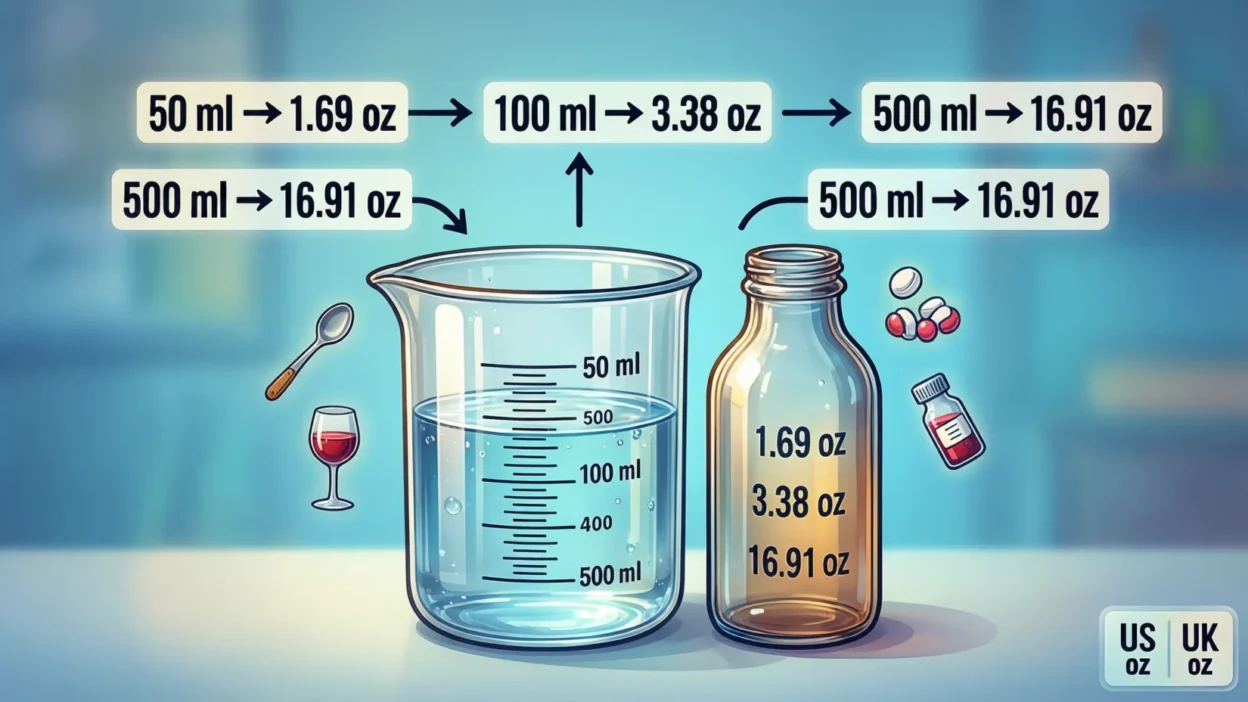
- 100 ml to oz ≈ 3.38 US oz
- 50 ml to oz ≈ 1.69 US oz
Milliliters allow precise measurements, making it easier to follow international recipes or medical instructions. Understanding ml is the first step in converting it accurately to ounces.
What Is an Ounce (oz)?
An ounce (oz) is an imperial unit of measurement. When measuring liquids, it is called a fluid ounce (fl oz).
- US fluid ounce: ≈ 29.5735 ml
- UK (Imperial) fluid ounce: ≈ 28.413 ml
Ounces are commonly used in recipes, drinks, bartending, and health measurements. For example:
- 30 ml to oz ≈ 1 US oz
- 60 ml to oz ≈ 2 US oz
Knowing the difference between weight ounces and fluid ounces ensures precise conversion.
Differences Between US and UK Ounces
US vs UK ounces have slight differences that matter when converting:
- US fluid ounce: 1 fl oz ≈ 29.5735 ml
- UK fluid ounce: 1 fl oz ≈ 28.413 ml
Examples:
- 200 ml to oz: US ≈ 6.76 oz | UK ≈ 7.04 oz
- 750 ml to oz: US ≈ 25.36 oz | UK ≈ 26.41 oz
Why it matters:
- Recipes & Baking: Prevents inconsistent results
- Cocktails & Drinks: Ensures correct ratios
- Medicine: Dosage accuracy is critical
How to Convert ML to OZ
Conversion Formulas
- US fluid ounce:
oz=ml29.5735\text{oz} = \frac{\text{ml}}{29.5735}oz=29.5735ml
- UK fluid ounce:
oz=ml28.413\text{oz} = \frac{\text{ml}}{28.413}oz=28.413ml
Step-by-Step Examples
- 150 ml to oz: 150 ÷ 29.5735 ≈ 5.07 US oz
- 375 ml to oz: 375 ÷ 29.5735 ≈ 12.68 US oz
- 500 ml to oz: 500 ÷ 29.5735 ≈ 16.91 US oz
- 300 ml to oz: 300 ÷ 29.5735 ≈ 10.14 US oz
Quick Mental Tips
- Roughly, 30 ml ≈ 1 US fl oz
- Small measurements like 10 ml to oz ≈ 0.34 US oz
ML to OZ Conversion Table
| Milliliters (ml) | US Ounces (oz) | UK Ounces (oz) |
| 10 ml | 0.34 oz | 0.35 oz |
| 30 ml | 1.01 oz | 1.06 oz |
| 40 ml | 1.35 oz | 1.41 oz |
| 50 ml | 1.69 oz | 1.76 oz |
| 60 ml | 2.03 oz | 2.11 oz |
| 75 ml | 2.54 oz | 2.64 oz |
| 100 ml | 3.38 oz | 3.52 oz |
| 120 ml | 4.06 oz | 4.22 oz |
| 150 ml | 5.07 oz | 5.28 oz |
| 187 ml | 6.32 oz | 6.58 oz |
| 200 ml | 6.76 oz | 7.04 oz |
| 250 ml | 8.45 oz | 8.80 oz |
| 300 ml | 10.14 oz | 10.57 oz |
| 375 ml | 12.68 oz | 13.19 oz |
| 400 ml | 13.52 oz | 14.09 oz |
| 500 ml | 16.91 oz | 17.60 oz |
| 750 ml | 25.36 oz | 26.41 oz |
Practical Examples of ML to OZ Conversion
Cooking & Baking
- 120 ml to oz milk ≈ 4.06 US oz
- 200 ml to oz oil ≈ 6.76 US oz
Drinks & Beverages
- 60 ml to oz liquor ≈ 2 US oz
- 300 ml to oz juice ≈ 10.14 US oz
Health & Medicine
- 10 ml to oz medicine ≈ 0.34 US oz
- 50 ml to oz syrup ≈ 1.69 US oz
Tools and Calculators for ML to OZ Conversion
- Online converters: UnitConverters.net, RapidTables.com
- Mobile apps: Unit Converter, ConvertPad
- Smart kitchen tools: Digital scales with ml-to-oz functions
- Built-in calculators:
- US oz: ml ÷ 29.5735
- UK oz: ml ÷ 28.413
- US oz: ml ÷ 29.5735
Common Mistakes When Converting ML to OZ
- Confusing US vs UK ounces
- Mixing weight oz and fluid oz
- Rounding errors (small amounts like 10–30 ml)
- Ignoring recipe units (US or UK)
- Forgetting measurement precision for medicine or drinks
Tips for Quick and Accurate Conversion
- Memorize common equivalents: 30 ml ≈ 1 US oz
- Use conversion tables for reference
- Utilize digital tools and calculators
- Always double-check recipe units
- Round small amounts carefully for accuracy
Frequently Asked Questions (FAQ)
Q1: How many ml are in an ounce?
- US fl oz ≈ 29.5735 ml | UK fl oz ≈ 28.413 ml
Q2: How many ounces in 100 ml?
- US ≈ 3.38 oz | UK ≈ 3.52 oz
Q3: How many ounces in 500 ml?
- US ≈ 16.91 oz | UK ≈ 17.60 oz
Q4: How many ounces in 750 ml?
- US ≈ 25.36 oz | UK ≈ 26.41 oz
Q5: Can I convert 10 ml to oz quickly?
- Yes, 10 ml ≈ 0.34 US oz, approximate for quick use
Q6: What is the difference between US and UK ounces?
- Slight difference in ml: US ≈ 29.5735 ml, UK ≈ 28.413 ml
Conclusion
Converting ml to oz is vital for cooking, drinks, and medicine.
Knowing the difference between US and UK fluid ounces ensures precision,
If measuring 500 ml to oz, 250 ml to oz, or even 10 ml to oz.
Using formulas, tables, and calculators makes conversion fast and accurate.
Memorizing key equivalents, checking units, and avoiding common mistakes ensures reliable results. With this guide, you can confidently convert ml to oz in any scenario—recipes, beverages, or health-related applications.